
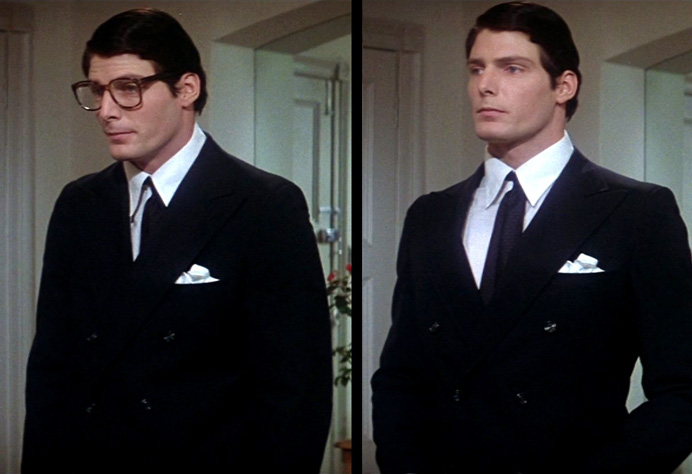
Look what simple posture does to your appearance! (It’s not the glasses that hid Superman

As a sports medicine and pain specialist who focuses on the neck, shoulder, and back issues, posture has been an essential part of my practice. In my office, our evaluation of posture plays an important role in both diagnosis and monitoring improvement in all the treatment protocols we prescribe. 12 years ago, I had a posture app that was available on the Apple store. Then about 9 years ago, I started a posture blog on the Google+ platform and had close to 80,000 followers. It was the #1 posture blog worldwide on the Google+ platform and was listed on their ‘featured’ page. Many of those articles are still available online and are full of outdated information.
What I believe is important in posture has changed over the last few years. If you were to read my articles concerning posture, you would see a pattern where I was extolling people to draw their tummy in and rotate their pelvis under them. Then work on building the endurance necessary to maintain this position all day. Now I would tell you the exact opposite.
Now I realize that posture is key to stability and building muscles of stability. My new edition of Uprise: The Body Guitar Theory and Back Pain Liberation discusses the way the body is stabilized in The Body Guitar Theory where two different muscle groups are pulling to create stability in an unstable part of the body. These two muscle groups are further defined as sympathetic and parasympathetic based on how the diaphragm is involved. These muscle group’s interaction is affected by and effects our stress, sleep, activity, digestion, along with everything else associated with the autonomic nervous system… along with how stable our body is and how it ages. In essence, the sympathetic group (which I call “String muscles”) activates during high-effort scenarios like sprinting or fight-or-flight responses, contracting more powerfully when the diaphragm is fixed or “locked” in place—creating intra-abdominal pressure for explosive stability. In contrast, the parasympathetic group aligns with relaxed, restorative states, promoting fluid diaphragmatic breathing and endurance-based tone.
Posture is a direct strengthening of the Bracing muscles. (Not to be confused with “bracing” which is the act of increasing intra-abdominal pressure or bearing down to lift something) The Bracing muscles are high tone, often short segment endurance muscles that pull joints of stability into themselves to create relaxed stability.
Instead of asking these Bracing muscles to contract all day, we instead strengthen these muscles and then expect the tone, or resting contraction of the muscle, to increase over time. Think of the arch of the foot. You aren’t holding your arch up, but the tone of the muscles in your foot is holding your arch in place. The same goes for other muscles involved with your posture. The more we use these muscles correctly, the more strength we gain and the more tone they achieve. This parasympathetic-like tone builds through low-load, endurance-focused exercises, fostering a “tuned” posture where the body maintains equilibrium against gravity without effort—much like the passive structure of a guitar’s wood providing foundational support. What are these exercises? Often they are prolonged correct posture. Correct posture creating the strength for posture.
When I was telling people to draw their tummy in and rotate their pelvis under them, I was creating tension in the body and in their muscles. I like to say that the people who did exactly as I instructed were essentially holding in a fart for 16 hours a day. This breath-holding and muscle tension was actually strengthening the tone of the sympathetic muscle group (I call these muscles String muscles) and working against the Bracing muscles as they are in opposition.
When we evaluate low back pain, one of the things we look for is whether someone has begun to breath-hold with activities. It speaks to an altered stabilization pattern and identifies weakness. By creating breath-holding in patients trying to improve their posture, we may have been worsening their stabilization and causing motion (or lack of motion) patterns that weren’t helpful. One of the things we try to accomplish in physical therapy is the elimination or severe reduction of these breath-holding moments. I was creating breath-holding hours.
Now the recommendations go like this. Sit up straight, draw your shoulders back some, allow an arch in your back and try to position your head over your shoulders. Now take a deep breath and relax. Let your butt cheeks relax. Settle into your feet and lower back. Keep the same position, but just do it relaxed. You were made stable, let the muscles that are supposed to stabilize you do it without all the tension. In a more straightforward explanation: sit up straight and then abdominal breathe.
I will explain more over the next few posts, but for now, let us just start with that. For those of you who followed my previous advice… including the above Superman – breathe with your diaphragm and relax into those joints!